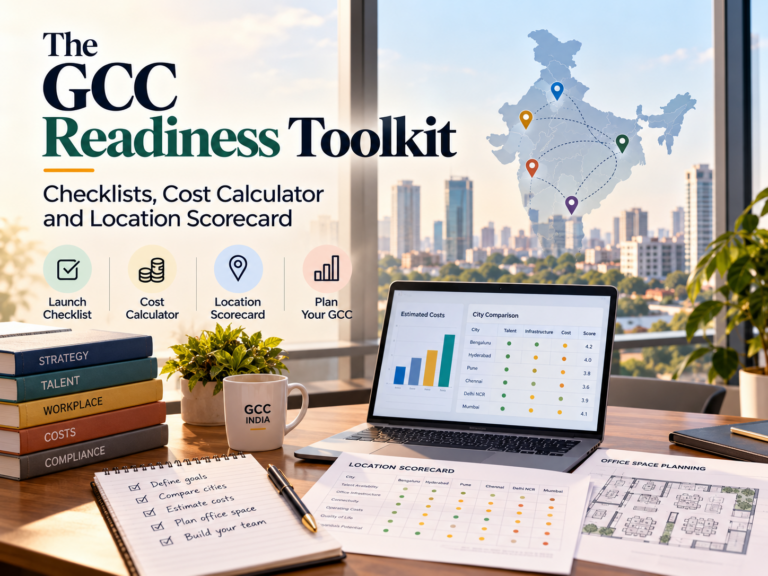
Setting up a Global Capability Centre (GCC) in India involves several decisions that need to work together. Companies must establish the right operating structure, recruit suitable talent, arrange technology and infrastructure, understand their compliance obligations and select a location that supports their long-term plans.
Some organisations manage these activities internally. Others work with external specialists to accelerate specific parts of the process or coordinate the setup from planning through launch.
The challenge is that a provider offering GCC setup support may not necessarily have expertise across every area the company needs. A legal adviser may understand incorporation but not recruitment strategy. A real estate provider may help secure an office but not design the operating model. A technology partner may build infrastructure without taking responsibility for workforce or business planning.
Choosing the right partner therefore requires a clear understanding of what the company needs, what the provider will deliver and which responsibilities must remain with the business.
This guide explains how to evaluate GCC implementation partners and structure the relationship around measurable outcomes.
1. Decide what support the GCC actually needs
Before approaching providers, define the scope of assistance required.
Some companies have experienced internal teams that can manage the setup but need help finding suitable office space or recruiting specialist employees. Others may be entering India for the first time and require support coordinating multiple workstreams.
Potential areas of support include:
- GCC strategy and operating-model design
- Legal entity establishment and compliance coordination
- Tax and financial planning
- Talent acquisition and workforce planning
- Technology infrastructure and cybersecurity
- Office location and workspace selection
- Vendor evaluation and procurement
- Operational readiness and launch coordination
- Ongoing facilities or administrative support
These services may come from different providers. There is no requirement to appoint a single firm for every workstream.
Start by identifying the activities your internal team can manage, the areas requiring specialist advice and the tasks where external coordination would add value.
This prevents the company from paying for services it does not need or assuming that a broad service description includes responsibilities that have not been agreed upon.
For a wider overview of the decisions involved, see The Complete Guide to Setting Up a Global Capability Center in India.
2. Evaluate relevant GCC experience
A provider’s general experience in India does not necessarily establish that it is suitable for your GCC.
Look for experience relevant to the proposed functions, operating model, scale and timeline. A company establishing a technology centre may need different support from one creating a finance operations hub or an engineering research facility.
During evaluation, ask prospective partners to explain:
- The types of GCC projects they have supported
- Their role in those projects
- The functions and operating models involved
- The challenges they encountered
- How they coordinated with the client’s internal teams
- Which responsibilities remained with the client
- What happened after launch
Ask for references or case studies where appropriate and permitted. Focus on what the provider actually delivered rather than relying only on the size or reputation of its client list.
A useful distinction is whether the provider has completed similar work or merely offers services that could theoretically support it.
For specialised matters such as tax, legal structure and regulatory compliance, verify the credentials and responsibilities of the professionals providing advice. These areas may require qualified advisers rather than a general implementation coordinator.
3. Assess whether the provider understands your operating model
The partner should understand what the GCC is expected to do, not simply how to establish an office or recruit employees.
A centre that will own global product development may need a different setup approach from one focused on standardised business operations.
Ask how the provider would approach your specific requirements. Can it identify the major decisions, dependencies and risks? Can it explain which activities should happen in parallel and which must be completed first?
A strong implementation plan should connect the operating model to the practical requirements of launching the centre.
For example, recruitment targets should reflect the approved business plan. Workspace decisions should account for expected headcount, security needs and timing. Technology setup should support the work employees are expected to perform.
The provider should also recognise where decisions require input from the parent organisation. An external partner cannot determine every business priority or approve every investment on the company’s behalf.
Flexo’s article GCC vs Shared Services Centre vs Outsourcing: Which Model Is Right for Your Business? can help companies clarify their preferred operating model before assessing providers.
4. Check the proposed team, not just the company
A provider may have an impressive corporate profile but assign a team with limited experience in the specific work required.
Ask who will lead the engagement and who will perform each major activity. Clarify whether the proposed experts will be directly involved or available only for occasional consultation.
The assessment should cover the following:
Project leadership
The engagement needs an accountable leader who can coordinate activities, manage dependencies and escalate issues.
Functional expertise
The team should include appropriate specialists for the work it has agreed to perform. Legal, tax, recruitment, technology and real estate requirements may require different expertise.
Local market knowledge
For location-sensitive decisions, assess the provider’s knowledge of the relevant city and business district. General familiarity with India may not be sufficient for a detailed micro-market assessment.
Coordination capability
The provider should explain how it will work with the company’s finance, HR, IT, legal and global leadership teams.
Continuity
Find out what happens if a key member of the provider’s team leaves or becomes unavailable. Ask whether responsibilities and documentation will be transferred to another qualified person.
The objective is to understand who will actually deliver the work and how the provider will maintain accountability throughout the engagement.
5. Compare the proposed scope and commercial terms
Price matters, but comparing providers only on their headline fees can be misleading.
One proposal may include detailed implementation support, while another covers only initial advice. A lower fee may also exclude services that the company later discovers it needs.
Request a written scope of work that specifies deliverables, assumptions, exclusions, dependencies and responsibilities.
The proposal should explain:
- What the provider will deliver
- Which activities are excluded
- What information or decisions the client must supply
- The expected timeline and milestones
- The fee structure and payment schedule
- How changes to the scope will be handled
- How delays or unresolved dependencies will be escalated
- Which expenses may be charged separately
Compare the total expected cost rather than the initial quotation alone.
For example, a company may need separate contracts for legal advice, recruitment, technology implementation and workspace. Its financial assessment should include all relevant providers and internal costs.
Avoid accepting vague commitments such as guaranteed savings or rapid setup without understanding the assumptions behind them.
6. Examine the implementation plan
A credible provider should be able to explain how the work will progress from planning to operational readiness.
The plan should identify major milestones, dependencies, decision points and the people responsible for completing each activity.
A typical sequence may include:
Discovery and requirements
The provider and client clarify the GCC mandate, expected functions, target headcount, budget and key constraints.
Planning and evaluation
The team assesses operating options, locations, recruitment requirements, infrastructure and relevant professional support.
Setup and mobilisation
Approved workstreams begin. These may include legal establishment, recruitment, technology preparation and workspace selection.
Readiness and testing
The company checks whether the people, systems, processes and facilities are ready for the planned operations.
Launch and stabilisation
The GCC begins work, outstanding issues are monitored and responsibilities are transferred to the operating team.
The exact sequence will vary. Some workstreams can run in parallel, while others depend on earlier decisions.
Ask how the provider will manage changes in requirements. If recruitment takes longer than expected or a workspace option becomes unavailable, the plan should have a process for reassessing the timeline and alternatives.
7. Evaluate workspace expertise separately
Workspace is an important part of GCC setup, but it should be assessed according to the company’s actual requirements.
A provider’s ability to source an office does not automatically mean it can advise on the full range of workspace options, commercial terms and capacity considerations.
Assess whether the provider understands:
- The shortlisted cities and relevant business districts
- Expected headcount and peak attendance
- The difference between coworking, managed offices and traditional leases
- Security and access requirements
- Connectivity and infrastructure needs
- Expansion and contraction options
- The total cost of occupancy
- The commercial and operational implications of each arrangement
Ask how workspace options will be compared and whether the recommendations will reflect the company’s approved requirements.
For example, a company planning a small initial team may prioritise speed and flexibility. A large GCC with confirmed long-term demand may need a more customised arrangement.
The provider should explain the trade-offs instead of assuming that one workspace model suits every business.
Flexo’s Bengaluru vs Hyderabad vs Pune: Which GCC Location Offers the Best Value? and Setting Up a GCC in Delhi NCR: Gurugram, Noida or Another Business District? provide location-specific context for companies evaluating these markets.
8. Review governance, reporting and accountability
The provider should not become an additional layer that makes decisions harder.
Agree on who will lead the engagement, how often progress will be reviewed and how decisions will be documented. Establish a clear escalation route for issues involving budget, timing, scope or compliance.
A project dashboard can track:
- Milestones completed
- Upcoming decisions
- Budget against approved estimates
- Hiring and onboarding progress
- Workspace and infrastructure readiness
- Outstanding risks and dependencies
- Changes to the scope or timeline
- Actions assigned to the client and provider
The dashboard should focus on information that helps the company make decisions. Reporting volume is not a substitute for useful project control.
The client must also retain visibility into the engagement. Even when external providers perform substantial work, the company remains responsible for making business decisions and ensuring that the resulting operation meets its requirements.
9. Understand data, intellectual property and confidentiality arrangements
A GCC implementation engagement may involve sensitive business information, employee data, financial projections, system details or commercial plans.
Before sharing such information, clarify how it will be accessed, stored, transferred and protected.
The agreement should address confidentiality, permitted data use, access controls, retention and deletion, incident reporting and any relevant subcontracting arrangements.
Where the provider creates documents, software, processes or other deliverables, confirm ownership and permitted use in the contract.
The arrangement should also explain what happens when the engagement ends. The client may need copies of project documentation, configuration records, vendor information and other materials to operate the GCC independently.
Legal and security teams should review the relevant terms before sensitive information is shared or access to critical systems is granted.
10. Plan for the period after launch
Implementation support should not end with the opening of the office unless that is what the company has agreed and the operating team is ready.
Some companies require assistance during a defined stabilisation period. Others may need ongoing facilities management, recruitment support, technology services or periodic specialist advice.
Determine which responsibilities must transfer to the GCC’s own management team and which services will continue externally.
The handover should include current documentation, outstanding issues, vendor contacts, operating procedures and clear ownership of unresolved tasks.
Avoid creating long-term dependence on a provider for information or activities that the company expects to manage internally.
If ongoing support is part of the proposal, evaluate its scope, service expectations, commercial terms and exit arrangements separately from the initial setup engagement.
11. Common mistakes when choosing a partner
Selecting a provider based only on price. A low initial fee may exclude essential services or create additional costs later.
Assuming one provider can handle everything. Some engagements require several specialists, and a single provider may not have appropriate expertise across all workstreams.
Failing to define the scope. Unclear deliverables and exclusions can lead to delays, disputes and unexpected expenditure.
Overlooking the proposed delivery team. The experience of the people doing the work matters as much as the provider’s overall reputation.
Treating launch as the final objective. The setup must leave the company with an operation that can function effectively after external support ends.
Failing to retain internal ownership. The company must remain responsible for strategic decisions, approvals and the business outcomes expected from the GCC.
12. A practical partner-selection checklist
Before making a decision, confirm that you have:
- Defined the GCC’s purpose, scope and expected scale.
- Identified which activities require external support.
- Evaluated relevant experience and professional qualifications.
- Reviewed the proposed delivery team.
- Obtained a detailed scope of work and list of exclusions.
- Compared fees, assumptions and likely additional costs.
- Reviewed the implementation plan and dependencies.
- Established reporting and escalation procedures.
- Assessed confidentiality, security and intellectual property terms.
- Clarified the handover and post-launch support arrangements.
- Checked references where available and appropriate.
- Documented how the provider’s performance will be evaluated.
Use the same evaluation criteria across shortlisted providers so that the comparison is consistent.
Frequently asked questions
Does every company setting up a GCC need an implementation partner?
No. Companies with sufficient internal expertise may manage the process themselves and engage specialists only where needed. External support is most useful when it fills a capability gap or helps coordinate complex work.
Should one provider manage the entire GCC setup?
Not necessarily. A single provider may simplify coordination, but separate specialists may be more suitable for particular requirements. The decision should reflect the scope, expertise and accountability needed.
How should companies compare implementation partners?
Compare relevant experience, the proposed team, deliverables, commercial terms, implementation approach, reporting and handover arrangements. Avoid relying on price or broad claims alone.
What should happen after the GCC launches?
Responsibilities should transfer to the operating team according to an agreed handover plan. Any ongoing services should have a separate, clearly defined scope and performance expectations.
Conclusion
Choosing a GCC implementation partner is a decision about expertise, accountability and the company’s ability to establish a sustainable operation.
The right provider should understand the GCC’s purpose, explain how it will deliver the agreed scope and coordinate effectively with the company’s internal teams. Its responsibilities, commercial terms and handover obligations should be documented before the engagement begins.
Companies do not need to outsource every part of the process. They need to identify where external support adds value, retain ownership of strategic decisions and ensure that the finished GCC can operate effectively after the setup phase.